
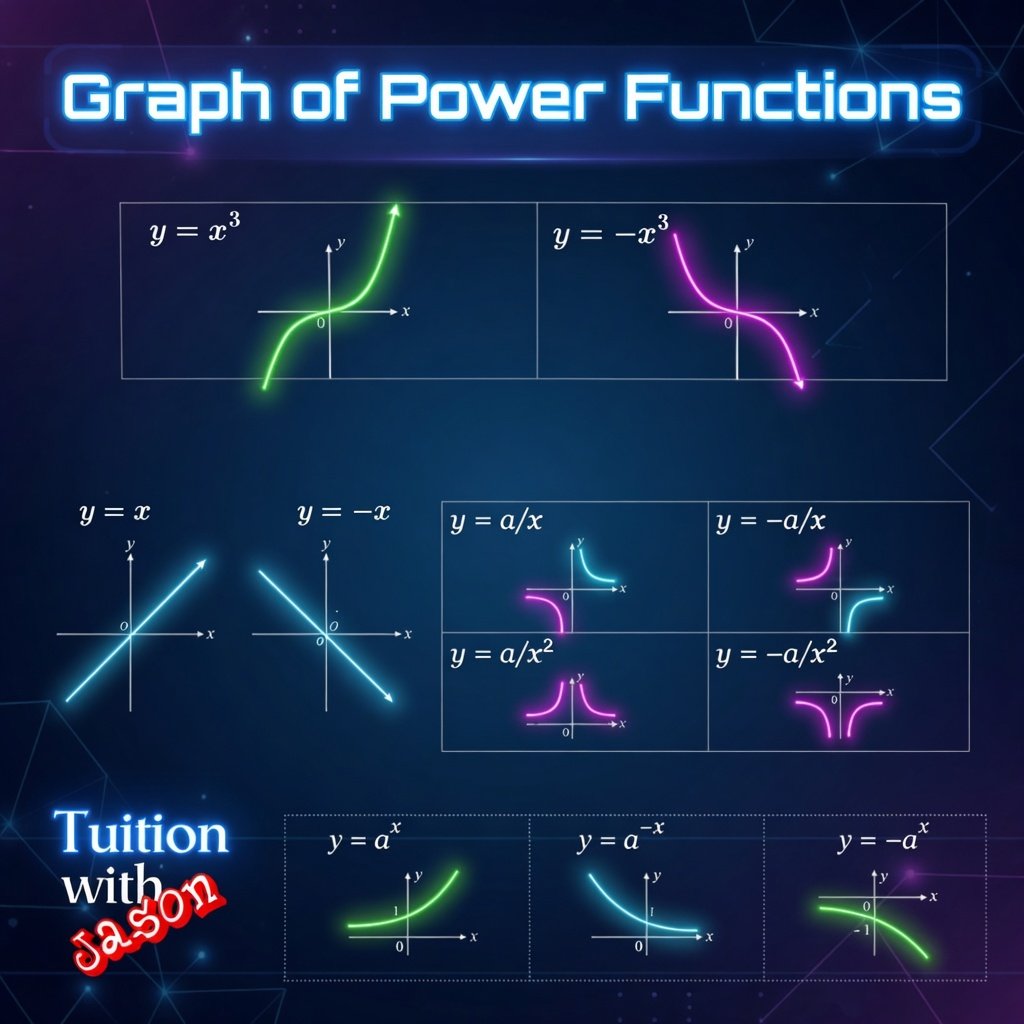
Power functions may look scary at first, but they follow clear patterns once you know what to observe. In Secondary 3 and 4 Mathematics, recognising the shape, symmetry, and direction of a graph can help you sketch faster and avoid careless mistakes.
For example, y=x2 forms a U-shape, while y=−x2 is reflected downwards. Cubic graphs like y=x3 and y=−x3 curve in opposite directions. Reciprocal graphs such as y=xa and y=x2a have separate branches and do not touch the axes.
Instead of memorising every graph blindly, ask yourself: Is the power odd or even? Is there a negative sign? Is the variable in the denominator? These small clues can tell you a lot about the graph before you even draw it.
A-Math and Math tuition at woodlands, admiralty, marsiling, canberra, yew tee, choa chu kang, sembawang, jurong west, boon lay and taman jurong